

Understanding the Dopamine Reward System
Dopamine is an evolutionarily ancient neurotransmitter that is found in both vertebrates and invertebrates. Comparative studies show us that there are several links between dopamine and behavioral responses subjected to reward. There are 5 different major pathways associated with the dopaminergic system.
- Mesolimbic Pathway: Dopamine is synthesized in the ventral tegmental area and transmitted into the limbic system via the nucleus accumbens. This is generally referred to as the reward pathway of the brain.
- Addiction is defined as compulsive, habitual need to use a particular substance (cocaine, opium, nicotine, caffeine).
- Mesocortical Pathway: Dopamine is synthesized in the ventral tegmental area and transmitted to the frontal cortex. This pathway is associated with working memory, motivation and emotion.
- Schizophrenia is a type of mental disorder that involves the breakdown of thought, emotion, and behavior resulting in inappropriate actions, such as withdrawal from relationships, delusions, mental fragmentation. This is caused by excess dopamine, hyper stimulation of D2R in the basal ganglia, and hypo stimulation of D1R in the frontal cortex. (Puig, et. al)
- ADHD (Attention Deficit Hyperactivity Disorder) is characterized by inattentiveness, impulsivity, and hyperactivity. The size of the PFC is reduced in these patients, and genes in the dopaminergic pathway altered. (Puig, et. al)
- Psychosis involves radical changes in personality, impaired functioning, and a distorted or nonexistent sense of objective reality.
- Nigrostriatal Pathway: Dopamine synthesized in the substantia nigra pars compacta and transmitted to the dorsal striatum. This pathway is associated with movement.
- Parkinson’s disease is a movement disorder characterized by loss of muscle control resulting in tremors, loss of balance, and stiffness. It is caused by degenerate neurons in the substantia nigra pars compacta and decrease in phasic and tonic PFC dopamine levels. (Puig, et. al)
- Tuberoinfundibular Pathway: Dopamine synthesized in the hypothalamus, stored in the pituitary. This pathway regulates the secretion of the hormone prolactin from the anterior pituitary gland.
At first glance, it seems like the dopaminergic system is about pleasure. Certain pleasurable stimulation’s activate certain neurons causing a release of dopamine. There is a variety of things that can cause these simulations, from cocaine, heroin, alcohol to sex, Instagram and skydiving. Some of the time we don’t even have to be directly involved in these simulations, we can just be imagining them and we can achieve some form of satisfaction or dopamine release. Food invokes a dopamine release release in hungry individuals of all species, with an added twist in humans. Show a picture of a milkshake to someone after they’ve consumed one, and there’s rarely a dopaminergic activation, there is a feeling of being full. However, with people who are on a strict diet, there’s further activation and stimulation. Basically if you are working to cut out milkshakes or sodas, just drinking one makes you want another one. Using Dr Robert Sapolsky’s book “behave” I will try and dive into some of it to create a better understanding of you.
The mesolimbic dopamine system also responds to pleasurable aesthetics. In one study people listened to a new music, the more stimulating the music or more activation’s of the accumbens, the more likely subjects were to buy the music after. And then we also have dopaminergic activation for cultural inventions, like say someone who is really into sports cars sees a picture of a sports car and their receptors go wild. Patterns of dopamine get really interesting when you get involved with social interaction. Some of the findings may give you a little bit of optimism and heart warming feelings. In one study a subject would play an economic game with someone, where a player is rewarded under two circumstances: (Circumstance 1) if both players cooperate, each receives a moderate reward. (Circumstance 2) Stabbing the other person in the back gets the subject a big reward, while the other gets nothing. While both outcomes increased dopaminergic activity, the bigger increase occurred after cooperation. Go figure lol, people get higher off helping each other even if the prize is bigger when hurting each other. Other research examined the economic behavior of punishing jerks. In one study subjects played a game where player B could screw over player A for profit. Depending on the round, player A could either do nothing, punish player B by having some of player B’s money taken( at no cost to player B), or the other option was to pay one unit of money to have two units taken from player B. Punishment activated the dopamine system, especially when subjects had to pay to punish… the greater the dopamine increase during no-cost punishment, the more willing someone was to pay to punish. Punishing social norm violations is satisfying. Another great study, carried out by Elizabeth Phelps of New York University, has to do with “overbidding” in auctions. Where people bid more money than anticipated. This is interpreted as reflecting the additional reward of competing against someone and winning in a bid war. In turn of course, winning is satisfying because of the social competition. Where as lets say winning the lottery isn’t socially competitive, it’s up to chance. Winning the lottery and winning a bid both activated dopaminergic signals in subjects but losing the lottery has very little effect, while losing a bidding war had inhibited a dopamine release. Not winning the lottery is bad luck; not winning an auction is social subordination.
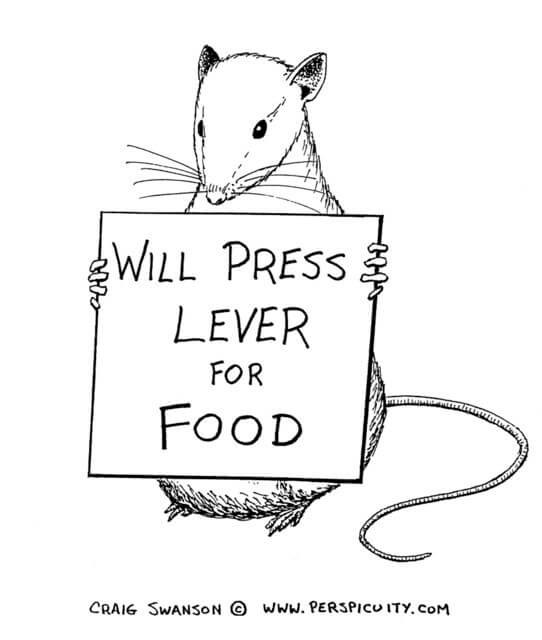
The Anticipation of Reward.
Dopamine is about mastery, expectation and confidence. It’s about the whole “ I know how this goes, this is going to be great” in other words, the pleasure is in the anticipation of reward, and the reward itself is nearly an afterthought… Unless of course , the reward fails to arrive, in which case its the most important thing in the world. Anticipation requires learning, learn that when I do this task, its reward time and your brain will fire off dopamine like crazy. This explains the craving of addiction. Suppose an alcoholic has been clean and sober for years. Return him or her to where the alcohol consumption used to occur and those synapses, those cues that were learned to be associated with alcohol, come roaring back into action, dopamine surges with anticipation, and the craving becomes overwhelming.
So we ask ourselves, can the anticipation of the reward eventually become rewarding itself? This has been shown by the Huda Akil of the University of Michigan. A light in the left side of a rat’s cage signals that lever pressing will produce a reward from a food chute on the right side. Remarkably, rats eventually will work for the chance to hang around on the left side of the cage, just because it feels so nice to be there. The signal has gained the dopaminergic power of what is being signaled. Similarly, rats will work to be exposed to a cue that signals that some kind of reward is likely, without knowing what or when. This is what fetishes are, in both the human social sense and sexual sense. This has shown us that the magnitude of an anticipatory dopamine rise reflects two variables. First the size of the anticipated reward. A monkey has learned that a light means ten presses earn ten units. And soon a tone stimulates more anticipatory dopamine than does a light. It’s “this is going to be great” versus “This is going to be great!” The second variable is pretty unique. The rule that the light comes on, you press the lever, you get the reward. Now things change. Light comes on, press the lever, get the reward.. Only 50 percent of the time. Remarkably, once that new scenario is learned, far more dopamine is released. Why? Because nothing fuels dopamine release like the “maybe” of intermittent reinforcement. This additional dopamine is released at a distinctive time. The light comes on in the 50 percent scenario, producing the usual anticipatory dopamine rise before the lever pressing starts. Back in the predictable days when lever pressing 100 percent of the time earned a reward, once the pressing was over with, dopamine levels remained low until the reward arrived, followed by a little dopamine blip. However, in this 50 percent situation, once the pressing is finished, dopamine levels start rising, driven by the uncertainty of “maybe yes, maybe no.”
Change things up even further to where the reward now occurs 25 or 75 percent of the time. A shift from 50 to 25 percent and a shift from 50 to 75 percent are exactly opposite, in terms of the likelihood of reward, and work from Brian Knutson, PhD shows that the greater the probability of reward, the more activation in the medial prefrontal cortex. However, switches from 50 to 25 percent and from 50 to 75 percent both reduce the significance of uncertainty. And the secondary rise of dopamine from a 25 or 75 percent likelihood of reward is smaller than for 50 percent. Showing us that the anticipatory dopamine release peaks with the greatest uncertainty as to whether a reward will occur. Now, when things are uncertain, high levels of anticipatory dopamine release is mostly in the mesocortical rather than the mesolimbic pathway, implying that uncertainty is a more cognitively complex state than is anticipation of predictable reward.
I can assure you, none of this is news to the big wig psychologists running Las Vegas. Logically, gambling should not trigger much anticipatory dopamine, given the astronomical odds against winning. However, the behavioral engineering… the 24/7 activity and lack of time cues, the cheap alcohol disrupting your frontal cortical judgment, the manipulations to make you feel like today is your day… distorts and shifts the perception of the odds into a range where dopamine pours out and the ohh, “maybe” i’ll win this time.

Pursuit
So in the end dopamine is more about the anticipation of reward than it is about the reward itself. Time for one more piece of the picture… Consider that monkey trained to respond to the light cue with lever pressing, and out comes the reward; as we now know, once that relationship is established, most dopamine release is anticipatory, occurring right after the cue. So what happens if the post-light cue release of dopamine does not occur? Crucially, the monkey does not press the lever. Similarly, if you destroy its accumbens, a rat makes impulsive choices, instead of holding out for a delayed larger reward. Conversely, back to the monkey… if instead of flashing the light cue you electrically stimulate the brain to release dopamine, amazingly enough, the monkey presses the lever. Dopamine is not just about the anticipation of the reward; it fuels the goal directed behavior needed to gain that reward: dopamine then “binds: the value of a reward to the resulting work. It’s about the motivation arising from those dopaminergic projections to the Prefrontal cortex that is needed to do the harder thing.. For example.. To work. In other words, dopamine is not about the happiness of reward. It is about the happiness of pursuit of reward that has a decent chance of happening.
This is very important when trying to understand the nature of motivation, as well as failing to be motivated during depression, where there is inhibition of dopamine singling thanks to stress, or in anxiety, where such inhibition is caused by projections from the amygdala. It also tells us about the source of the frontocortical power behind willpower. In a task where one chooses between an immediate and a larger delayed reward, contemplating the immediate reward activates limbic targets of dopamine( the mesolimbic pathway) where as contemplating the delayed reward activates frontocortical targets (the mesocortical pathway). The greater the activation of the latter, the more likely there will be gratification postponement.
These studies involved scenarios of a short burst of work soon followed by reward. What about when the work required is prolonged, and the reward is substantially delayed? In that scenario there is a secondary rise of dopamine, a gradual increase that fuels the sustained work; the extent of the dopamine ramp-up is a function of the length of the delay and the anticipated size of the reward.
A final Small Topic: Serotonin
As we have discussed dopamine and its role in our lives… let’s move over to an additional neurotransmitter, serotonin. Serotonin plays a clear role in some behaviors that concern us. Starting with a study done back in 1979, low levels of serotonin in the brain were shown to be associated with elevated levels of human aggression, with endpoints ranging from psychological measures of hostility to overt violence. A similar serotonin/aggression relationship was observed in other mammals and, remarkably, even crickets, mollusks and crustaceans. As work continued, an important qualifier emerged… Low serotonin didn’t predict premeditated, instrumental violence. It predicted impulsive aggression, as well as cognitive impulsivity. Other studies linked low serotonin to impulsive suicide. Basically, in both animals and humans pharmacologically decreasing serotonin signaling increases behavioral and cognitive impulsiveness. Importantly, while increasing serotonin signaling did not lessen impulsiveness in normal subjects, it did in subjects prone toward impulsivity, such as adolescents with conduct disorder. How does serotonin do this? Serotonin is all ends up affecting the same parts of the brain that deal with goal directed behavior. This is of course subject to change based on genes and other factors.
In conclusion
Life is about the pursuit of happiness, and not the end result. That is why we are never where we want to be, because the most satisfaction comes in the pursuit of goal directed behavior. The quicker the dopamine stimulation the less it becomes satisfying over time. You can translate this information into our worst habits, like say being in a toxic relationship where you are optimistic that your partner might change or you can change them and it only happens half the time. Another example is if you work really hard and your boss only acknowledges it with affirmation or raises half of the time, it will be an intoxicating situation. A lot of the most intoxicating things in life, whether they are healthy or unhealthy are a direct result of how our dopamine response system works and I hope that this article sheds enough light on the system to help you get a better handle on you and your life.
